GTAP University (GTAP-U): GTAPinR Course
GTAPinR Course
"Running the GTAP Model using R packages HARr and tabloToR"
|
Enroll in this course on your own schedule!
|
Why You Should Enroll
Enhance your GTAP skills with open-source R tools designed to streamline simulation and analysis!
-
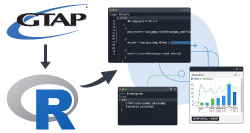
 Execute the GTAP Model directly in R
Learn how to run GTAP simulations end-to-end within the R environment using the open-source HARr and tabloToR packages
-
 Streamline data handling and model workflows
Gain practical skills in reading and writing GTAP data, solution files, and header arrays directly in R, enabling more efficient experiment setup and result processing
-
 Build practical skills for GTAP workflows
Build hands-on skills in GTAP workflows – setting closures, applying shocks, solving the model, and extracting results all in R environment
-
 Strengthen policy analysis with advanced visualization
Turn outputs into insight with R visualization workflows, improving interpretation, communication, and presentation of simulation results
-
 Flexible, self-paced learning for busy schedules
With open enrollment and a 56-day completion window, the course is designed to fit into busy schedules while providing structured modules, practical exercises and assessments
Course Content
Objective
This course aims to empower GTAP users with practical tools in R statistical software to enhance simulation analysis for policy making through improved processing of economic model outputs. The specific objective of this course is to introduce the R packages "HARr" and "tabloToR" which are open-source programs specifically designed to interface with the GTAP Model, as well as its outputs and inputs. The "HARr" package serves as a bridge between the GTAP Data Bases and the R environment by enabling the reading and writing of the header array (.har) file format adopted in the GEMPACK suite. The "tabloToR" package facilitates GTAP simulations by interpreting the model in GEMPACK-style TABLO (.tab) files and solves it within the R environment after the model inputs are defined. This course covers topics such as basic installation of the R packages, utilizing its features, as well as data visualization emphasizing practical, hands-on experience. This course is geared towards current users of the GTAP Model who are interested in running the model and processing its inputs and outputs within the R environment.
During the online, self-paced course, participants will:
- Learn about the "HARr" and "tabloToR" packages, including installation in the R environment
- Explore the specific commands and syntax necessary to run the GTAP Model, as well as reading and writing its inputs and outputs in the R environment
- Observe detailed instructions on how to utilize the features of these packages via hands-on experience
- Understand the limitations of these packages in practical applications
- Develop skills in visualizing data within the R environment to better interpret model outputs
By the end of this course, participants will be able to:
- Follow the general workflow for executing the GTAP Model within the R environment
- Read and extract data from solution files, as well as access and write header array files using the "HARr" package
- Set-up and run their own experiments using the "tabloToR" package
- Visualize data in R to support simulation analysis
Structure
The course is delivered fully online and includes reading materials, codes, audio-visual lectures, hands-on exercises, and weekly assessments, all designed to enhance learning. As a self-paced online course, participants will work through the weekly plan of study outlined in the learning management system. Since the course is self-paced, instructor assistance is not available during or after the course. No feedback or grading beyond automated assessments will be provided. Learners will have 56 days from the date access to the learning management system was granted, to complete the course before access ends.
Content Overview
-
Module 1 - "Getting Started with GTAPinR"
In this module, participants will:
- become familiar with the learning management system
- install R statistical software, RStudio and the required R libraries used in the course
- review materials on R basics and complete the assigned readings
- receive an overview of the "HARr" and the "tabloToR " R packages
- review the R data structures used throughout the course
- complete the assigned hands-on exercises and Quiz 1
-
Module 2 - "Reading and Writing Databases with HARr"
In this module, participants will:
- review materials on viewing data header array (.har) files and complete the assigned readings
- learn how to read and explore header array (.har) and solution files (.sl4) within the R environment
- follow hands-on instructions for reading data from these files and processing them in R using the "tidyverse" and "dplyr" packages
- practice writing data from R to header array (.har) format
- visualize data using the "ggplot2" and "ggalluvial" packages in R
- complete the assigned hands-on exercises and Quiz 2
-
Module 3 - "Solving the Model with tabloToR"
In this module, participants will:
- review the overall workflow for solving the GTAP Model in R
- learn how to initialize the GTAP Data Base files in R
- follow the step-by-step example for running the package, including how to:
- assign the model file and model database to the 'GEmodel' object
- specify the model closure and shocks
- select the solution method and solve the model
- explore model output list object generated in R
- extract percentage changes and updated values of key variables in the GTAP Model
- create simple visualizations using the "ggplot2" and "ggalluvial" packages in R
- complete the assigned hands-on exercises and Quiz 3
-
Module 4 - "Wrap-Up and Evaluation"
In this module, participants will:
- receive an overview of more advanced R packages, such as gtaptools, gtapssp, GTAPViz, and HARplus to further expand their GTAP skills
- learn how to stay engaged with the GTAP community after completing the course
- complete the final course evaluation
Time Commitment
Participants should expect to spend approximately 2-6 hours per module on this course.
Enrollment
Prerequisites
Participants are expected to know how to run the GTAP Model and be familiar with the inputs used in running the model. Participants are also expected to know how to use R statistical software. Open-source introductory- and intermediate-level tutorial materials on how to use R software are available online.
Registration
Individuals interested in enrolling in this course must register on the GTAP website, after which they will be provided details for making payment by bank transfer or credit card. Once payment has been received and access to the learning management system has been granted, learners will have 56 days to complete the course before access ends. Since this course is self-paced, instructor assistance is not provided.
To ensure fairness and consistency for all participants, registration fees are charged at the published rates and are not subject to individual negotiation or discount. Financial assistance through GTAP is not available. Applicants are encouraged to explore funding opportunities through their employer, institution, government, or other external sources.
|
Fees (USD)
|
Developed Country
|
Developing Country1
|
|
Professionals
|
$625
|
$470
|
|
Students2
|
$315
|
$160
|
Rate Details and Eligibility Requirements
- Developing Country Rates - In order to be eligible for a discounted, developing country rate, applicants must currently be residing in a country listed on the "GTAP Developing Countries List".
- Student Rates - Student rates are only available to current, full-time students. Post-docs and students concurrently working in any professional capacity are not eligible for these rates. Students will be required to provide proof of current, full-time student status/enrollment when registering.
Cancellation/Refund Policy
No refunds will be issued once payment has been received.
System Requirements
Participant computers and setup must meet the following specifications.
- Computer Requirements
- Other Requirements
Note on YouTube
During this course, some online materials are hosted on YouTube; therefore, participants must have the ability to access YouTube in order to view these videos. If a participant is unable to access YouTube, they must have access to a VPN or remote computer as video source files will not be provided.
|
Course Graduates
|
12 individuals from 6 different countries completed the GTAPinR Course.
- Ahmed, Adeel
RMIT, Pakistan
- Benavidez-Brouk, Lauren
Center for Global Trade Analysis, Department of Agricultural Economics, Purdue University, United States
- Florez Mendoza, Javier
The Vienna Institute for International Economic Studies wiiw, Austria
- Golub, Alla
Center for Global Trade Analysis, Purdue University, United States
- Jeong, Junyoung
Center for Global Trade Analysis, Purdue University, United States
- Karami, Omid
American Soybean Association, United States
- Okiya, Stephen
University of Nairobi, Kenya
- Puangchit, Pattawee
Center for Global Trade Analysis, Department of Agricultural Economics, Purdue University, United States
- Setie, Kassaw
Wollo University, Ethiopia
- Sikora-Kruszka, Dominika
EY, Poland
- Srikanth, Kavitha
Center for Global Trade Analysis, Department of Agricultural Economics, Purdue University, United States
- Wolf, Rayan
Center for Global Trade Analysis, Department of Agricultural Economics, Purdue University, United States
|
Last Modified: Tuesday, September 8, 2026